Staff Answer
Jun 26, 2026 - 07:45 AM
Do you have the same question? Follow this Question
Jun 26, 2026 - 07:45 AM
View all Destin Parasailing Questions & Answers
We’ve provided several answers to questions related to Destin Parasailing , see some other helpful Q&A related to this product.
Question: Will companies still go parasailing even if the wind is blowing hard?
Answer: That depends on how hard the wind is blowing, but the short answer is no. Parasailing companies are very cautious when it comes to weather because safety always comes first. A light breeze is actually ideal for parasailing, but once sustained winds start getting into the 20 to 25 mph range, many companies will begin delaying or canceling trips, although every operator has its own policies, equipment, and safety limits. Gusty winds can be an even bigger concern than steady winds because they create changing conditions that are harder to predict. The captains are checking the weather throughout the day, not just before the first trip leaves the dock. They are watching wind speed, gusts, wave height, visibility, and any storms that could affect the ride. I have seen mornings where the Gulf was almost flat and every trip went out on time, then by early afternoon the wind picked up enough that the remaining trips were canceled. I have also seen days where the forecast looked questionable, but the wind settled down and everyone was able to fly. If your reservation is affected by the weather, most companies will try to move you to another available departure or offer a refund if they cannot accommodate you. My advice is not to assume your trip is canceled just because it feels windy on the beach. Conditions can be very different once you get closer to the pass or farther out on the Gulf. Trust the captain's decision because they spend hundreds of days on the water every year, and no reputable parasailing company is going to risk flying guests when the wind is outside of safe operating conditions.
Question: If I'm flying solo parasailing, while they put me in the harness with someone random or will I go alone?
Answer: If you book a solo parasailing flight, you might end up paired with someone else (sometimes even a crew member) since each company has different policies. Your weight plays a big role, as weather conditions and sail size determine safe flying limits. Because of this, there isn’t a universal weight limit, and many parasailing companies actually avoid flying singles altogether to be cautious. If a company does allow solo flyers, they may arrange for a crew member to accompany you, or ask another guest if they’d like to fly again. It’s always best to carefully read the information on the listing or call TripShock at 850-424-5125 in advance to confirm which companies offer solo flights and what their specific requirements are.
Question: Can you hold a phone or selfie stick while parasailing in the air?
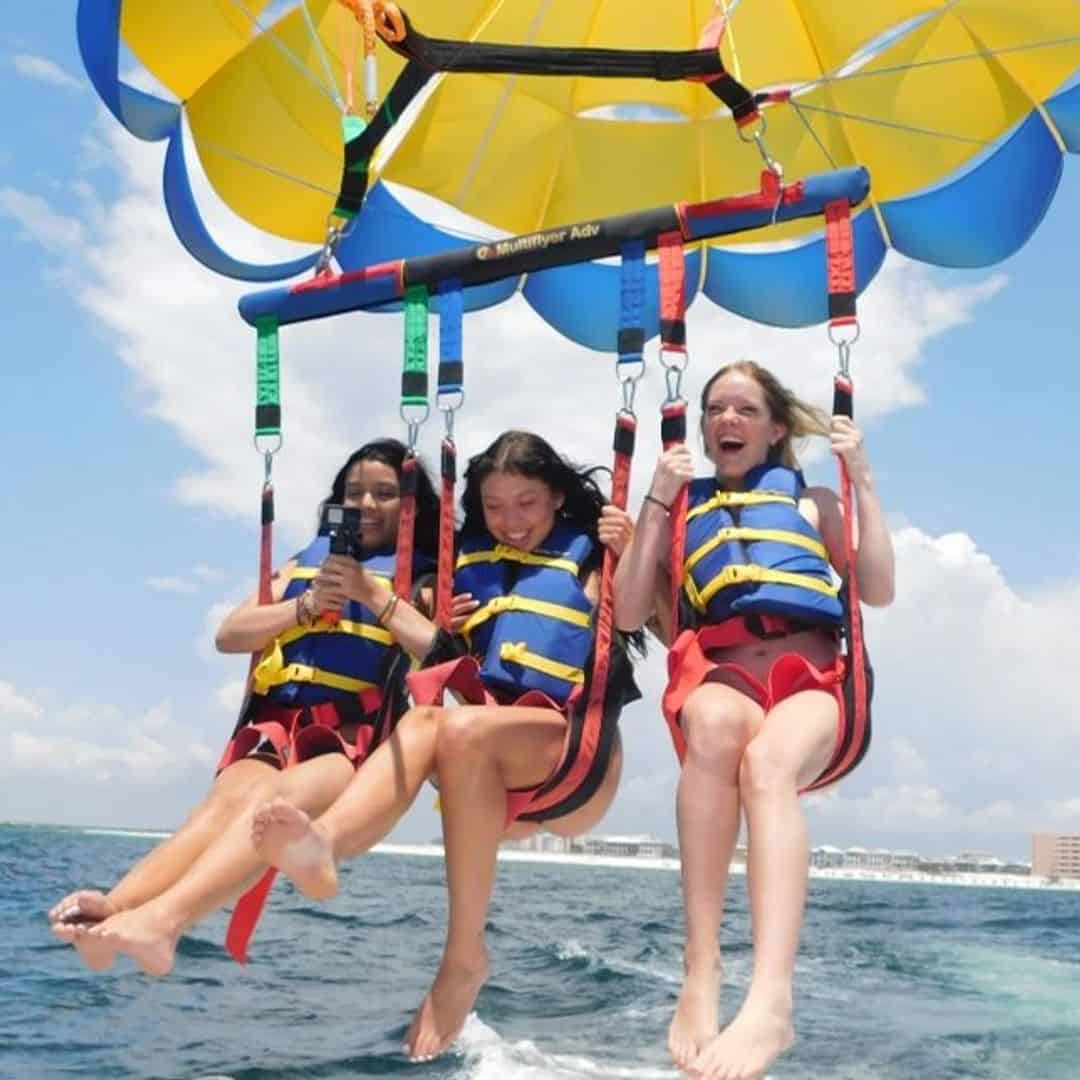
Answer: Technically, it depends on the company, but I usually tell people not to plan on holding their phone or a selfie stick while they are in the air. Many parasailing operators have rules against it because if you accidentally drop your phone, it is gone. There is no getting it back once it falls into the Gulf, and a falling phone could also be dangerous for the boat or people below. Some companies will allow you to bring a phone if it is securely attached with a wrist strap or kept in a waterproof case that is designed to float, but others will ask you to leave it on the boat altogether. Selfie sticks are even more likely to be prohibited because they are harder to control once you are in the air and can interfere with the harness or lines. If taking photos is important to you, I usually recommend asking the company whether they offer a photo or video package. Most crews have cameras and know exactly when to capture the best moments during takeoff, while you are flying, and when you come back down. The quality is usually much better than trying to snap pictures yourself while you are hundreds of feet above the water. My advice is to spend those few minutes enjoying the experience instead of worrying about your phone. The view of the emerald water, the beaches, and the coastline is something you will remember long after the trip is over, and it is a lot more relaxing when you are not gripping an expensive phone the entire time hoping it does not slip out of your hand.
Question: What happens if you fall out of the harness when parasailing?
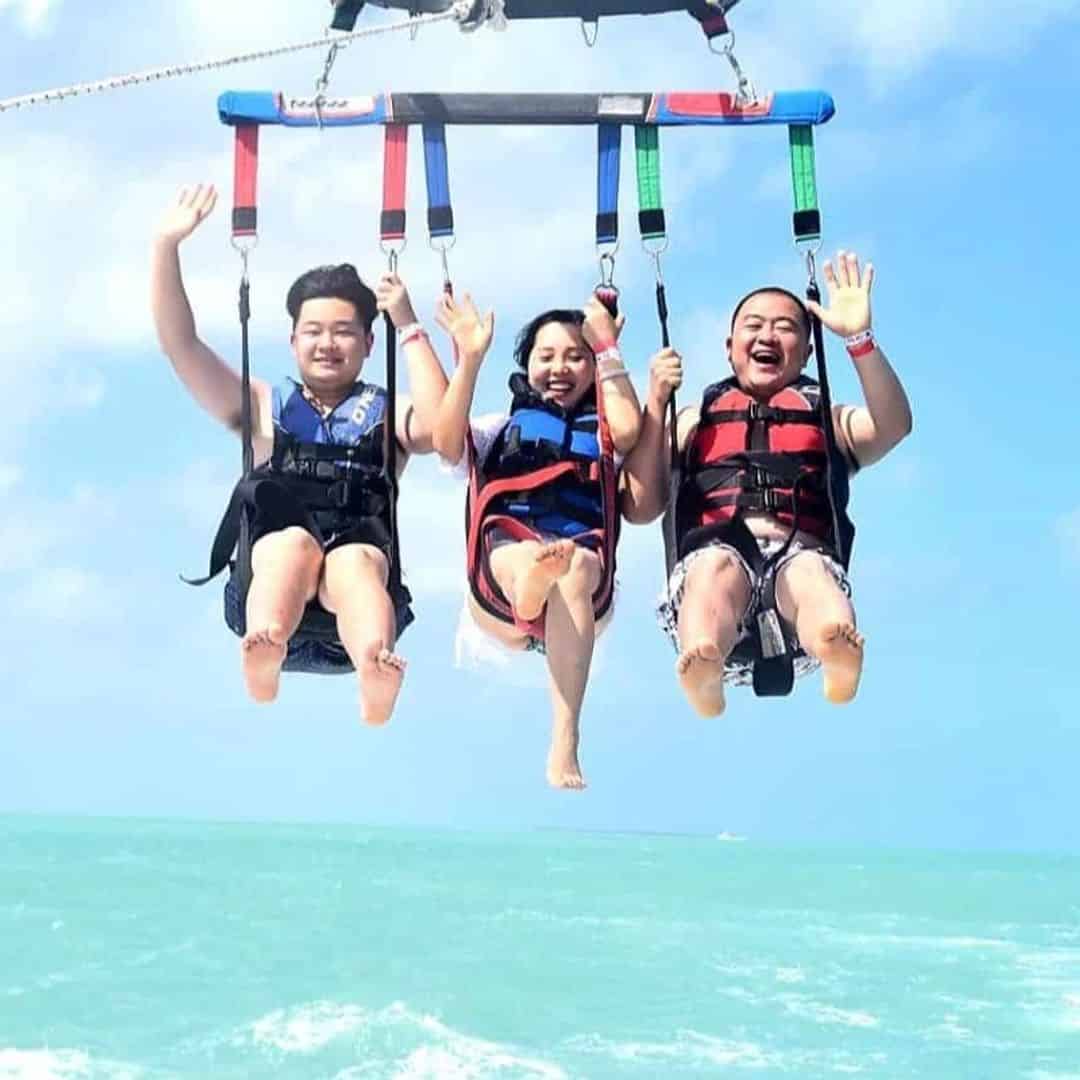
Answer: That is probably the most common fear first time parasailers have, but the reality is that it is extraordinarily unlikely to happen when you are flying with a reputable company. Before you ever leave the boat, the crew takes time to fit your harness correctly, double checks every connection, and makes sure everything is secure. The harness is designed to support your weight while keeping you comfortably seated throughout the entire flight, so you are not hanging on with your hands or relying on your own strength. Once you are in the air, you are actually sitting back in the harness much like you would sit in a swing. The only thing you really have to do is relax and enjoy the view. The crews in Destin perform these flights every day, and checking the equipment before each takeoff is simply part of their routine. If something does not look right, nobody leaves the boat until it is corrected. I tell nervous guests that they are much more likely to get tired from smiling than from holding on because there is nothing you need to grip to stay in place. If you look at videos of people parasailing, you will notice that many flyers have their hands resting in their lap or waving to the boat below. That should give you a good idea of how secure the harness feels once you are airborne. It is completely normal to think about that scenario before your first flight, but after talking with countless visitors over the years, almost everyone says that concern disappeared within the first few seconds because they immediately realized how stable and secure the ride actually feels.
Question: Has anyone ever had a shark try to bite them when parasailing?
Answer: No, that is not something people need to worry about. Sharks do not mistake someone parasailing hundreds of feet above the water for prey, and there are no documented cases of a shark trying to bite someone while they were actually parasailing. The only time you are close to the water is during takeoff, landing, or if you choose a quick water dip, and even then it only lasts a few seconds. Sharks are wild animals, and they certainly live in the Gulf, but they are not hanging around waiting for parasailers. In fact, if you are lucky enough to spot one from the air, it is usually a pretty exciting moment because you are seeing it from a safe distance. I have heard far more stories about people spotting dolphins, sea turtles, and stingrays than sharks. The captains are also on the water every day and keep an eye on conditions. If they ever saw anything that raised a safety concern, they would simply avoid that area. I always tell first time visitors that the biggest surprise about parasailing is how peaceful it feels. Once you are in the air, you stop thinking about what is in the water below and start taking in the incredible views of the coastline and the emerald water.
Question: Can I go parasailing with flip flops on?
Answer: Yes, you usually can, but you won't when you are flying. Most parasailing companies will let you wear flip flops on the boat, but many guests end up taking them off before they fly. Once you are in the air, there is always a chance a loose flip flop could slip off your foot and fall into the water. If that happens, it is probably gone for good. I usually tell people to either go barefoot or wear sandals with a secure heel strap if they want to keep their footwear on. The deck of the boat is designed to be comfortable on bare feet, and most people find it easier not having to think about their shoes while they are flying. If you do wear flip flops to the marina, the crew will usually have a place where you can leave them on the boat during your flight. It is one less thing to worry about, and you can focus on enjoying the experience instead of wondering whether your sandals are about to end up at the bottom of the Gulf.
Question: Can I go parasailing in jeans?
Answer: You can, but it's not the ideal clothing for this activity, especially during the warmer months. Jeans tend to get hot, they do not dry quickly, and they can feel pretty uncomfortable if you end up getting splashed or choose a water dip during your flight. Most people wear a swimsuit, shorts, or lightweight athletic clothing because it is much cooler and much more comfortable on the boat. Even if you plan on staying completely dry, there is always a chance of getting a little spray during the ride out. If you are visiting during the spring or fall and it is a little cooler outside, lightweight pants are a much better choice than heavy denim. My advice is to dress as if you are spending a few hours at the beach. Comfortable clothing that dries quickly will make the entire trip more enjoyable, and you will not have to worry about sitting in wet jeans for the rest of the day after your adventure is over.
Question: How likely is it that my parasailing trip will include a dolphin encounter compared to a dedicated dolphin cruise?
Answer: A dedicated dolphin cruise will almost always give you better odds if seeing dolphins is your main goal. Those captains spend much of the trip actively looking for dolphins and often know the areas where they have been spotted recently. Parasailing trips are different because the main focus is getting passengers airborne safely and providing an amazing flight experience. That does not mean dolphins are uncommon. In fact, plenty of parasailing guests see them during their excursion. Dolphins are usually spotted around Orange Beach and Gulf Shores, and there are days when they seem to be everywhere. A dolphin cruise is specifically designed around wildlife viewing, while parasailing treats dolphin sightings as an added bonus. One benefit of parasailing is the higher elevation. From above, you may notice movement in the water that would be harder to spot from the boat.
Question: If I’m bringing teenagers who act confident but have never done anything like this before, what reactions do crews typically see once they get airborne?
Answer: This is actually pretty entertaining to watch. A lot of teenagers show up acting completely fearless, talking about how easy it is going to be, and how they cannot wait to get up there. Then, takeoff starts, and you suddenly see a very different expression on their faces for the first few seconds. What usually happens next is that they settle in quickly and start enjoying themselves. By the time they land, many of them are asking if they can go again. Crews see this pattern all the time. Some teens become quiet once they are airborne because they are taking in the views, while others come down talking nonstop about everything they saw. The confidence is often real, but there is still a natural moment of uncertainty when they realize they are actually hundreds of feet above the water. Parents are often the ones worrying beforehand, while the teenagers end up adapting almost immediately.
Question: What does the landing process actually feel like, and is it more difficult than takeoff for nervous first timers?
Answer: Before their flight, many people think there is some complicated process where they have to time their steps perfectly or brace for a sudden impact. What usually happens is much easier. As the boat crew brings you back in, you gradually descend toward the platform on the boat. The process is controlled and steady rather than abrupt. For nervous flyers, the landing is often easier because by that point, they already know what the experience feels like. The uncertainty is gone. During takeoff, you are wondering what to expect. During landing, you have already spent several minutes in the air and have confidence in the equipment and crew.
Question: How crowded does the sky get during peak tourist season, and can you end up seeing multiple parasails at the same time?
Answer: During busy summer weeks, it is possible to see multiple parasails in the distance, especially on clear days when lots of visitors are out on the water. It rarely feels crowded from the perspective of someone actually flying. The Gulf is a large area, and operators are spread out across different sections of the coastline. From the beach, you might notice several colorful parachutes at once, but when you are up in the air, they are usually far enough away that they do not affect the experience. Most people spend their time looking at the water, boats, beaches, and coastline rather than searching for other parasails anyway. You may see fishing boats, dolphin cruises, personal watercraft, and parasails scattered throughout the area, but it generally adds to the atmosphere rather than taking away from it. The sky never feels packed the way a crowded beach might. There is still plenty of room to enjoy the scenery without feeling like you are sharing every inch of airspace with other groups.
Question: What do I need to know about parasailing safety in Gulf Shores and Orange Beach?
Answer: Many people think that parasailing is some extreme activity reserved for thrill seekers. Parasailing equipment and boats are designed to make the process simple for a wide range of ages and abilities. Some visitors worry they will be hanging on with their own strength the entire time, which is not how it works. The harness system supports you throughout the flight. Local operators have a strong incentive to make safety a priority because their reputation depends on it. Most guests leave with a very different impression than they had before arriving. Instead of feeling like they survived some intense adventure, they often describe it as peaceful, scenic, and comfortable.
Question: If I’m celebrating a birthday or other special occasion, are there ways local parasailing operators can personalize the experience?
Answer: Absolutely. The level of personalization depends on the operator, but many crews enjoy helping make special occasions memorable when they know about them ahead of time. If you are planning something important, call in advance rather than mentioning it at check in. That gives the crew time to set up the experience. Some people coordinate surprise photos, while others arrange for a proposal either before or after the flight. Families have turned a parasailing trip into the highlight of an entire vacation celebration. Even a simple announcement to the group onboard can make someone feel celebrated. If you communicate your plans early and work with the staff, there are often ways to make the occasion feel more personal without turning it into a complicated production.
Question: How physically demanding is parasailing for older adults who are active but not athletic?
Answer: Parasailing does not need much physical effort. You do not need to be highly athletic, and you are not climbing, paddling, swimming long distances, or doing anything strenuous. For active older adults, the biggest requirement is usually being able to get on and off the boat safely and follow simple instructions from the crew. The takeoff and landing process on parasailing boats is generally smooth. Many grandparents enjoy parasailing for the first time and come back saying it was much easier than expected. Of course, every person is different, and anyone with specific medical concerns should check with their doctor and the operator beforehand. From a physical standpoint, parasailing is one of the more accessible adventure activities available in Orange Beach.
Question: What happens if someone starts feeling scared after the parachute is already being deployed from the boat?
Answer: Crews deal with nervous passengers all the time and know how to recognize when someone is feeling anxious. If a person becomes scared during the launch, the crew is already helping them stay calm. At takeoff, you are not suddenly launched into the air. The boat moves forward, and you slowly rise, which gives you time to settle into the experience. Since the crews are accustomed to handling nerves, they will explain what is happening throughout the process. If someone is truly uncomfortable before leaving the boat, they should communicate that right away. The important thing is not to stay silent.
Question: Is there a noticeable difference in the experience between flying solo, tandem, and triple parasailing flights?
Answer: There definitely is. Flying solo feels a little more personal because it is just you and the scenery. Tandem flights are popular because you can share the experience with someone else. Couples, friends, and family members often enjoy being able to react together while they are in the air. Triple flights can be a lot of fun as well, especially for groups that want to experience it at the same time. The biggest difference is the atmosphere. Solo flights feel reflective, while tandem and triple flights feel more social. If someone in your group is nervous, pairing them with a confident friend or family member can sometimes help.
Question: How often do parasailing trips get canceled at the last minute during peak summer season in Orange Beach?
Answer: When that does happen, it is for good reasons. Summer weather along the Alabama coast can change pretty quickly, and conditions that look perfectly fine from the beach can be different once you get out on the water. Thunderstorms are the biggest factor. During June, July, and August, it is not unusual for storms to develop in the afternoon even after a sunny morning. Captains are constantly monitoring radar, wind speeds, and conditions offshore, so sometimes a cancellation decision is made close to departure time. Operators do everything they can to avoid canceling unnecessarily because they want to get people on the water. Morning departures experience fewer weather interruptions than later trips during the hottest part of summer. While cancellations certainly happen, they are not so common that you should worry about booking. Most trips go out as planned.
Question: If I’m traveling with family members who don’t want to parasail, is the boat ride itself entertaining enough for them to enjoy?
Answer: The answer is yes in most cases. Non flyers often end up enjoying themselves too. The boat ride gives you a chance to get out on the water, take in the scenery, and watch everyone else experience their flight. There is usually a lot of excitement when someone takes off and even more when they come back down. Family members often spend their time taking photos, looking for dolphins, and taking in the views of the coastline. Kids especially like watching the launch and landing process. Many grandparents, spouses, and friends who never intended to fly still talked about how much they enjoyed being part of the outing. Of course, if someone dislikes boats or gets seasick very easily, they may not enjoy it quite as much. If your family wants to stay together and share the experience, parasailing trips provide enough entertainment for everyone, even if only a few people are actually heading up into the air.
Question: What parts of Gulf Shores and Orange Beach can you realistically see from the highest parasailing altitudes?
Answer: From higher parasailing altitudes, you will have views of Orange Beach, portions of Gulf Shores, the Gulf waters extending toward many of the bays and waterways behind the beach communities. From ground level, visitors often focus on a specific beach area or resort, but from above, you will get a much larger picture of the region. You can spot marinas, bridges, boats moving through channels, and long stretches of shoreline. The exact visibility depends on weather conditions, humidity, and haze levels. Some days it appears incredibly sharp, while other days distant features fade. Even when visibility is average, the view is amazing because you can see the contrast between the bright beaches, green waterways, and deep blue Gulf.
Question: Is parasailing in the morning noticeably different from parasailing in the afternoon when it comes to visibility, heat, and water conditions?
Answer: Yes, there can be a noticeable difference, especially during the warmer months. Morning trips are often preferred by locals because the temperatures are more comfortable, the humidity is usually lower, and the water is calmer. The Gulf often has a smoother appearance early in the day before afternoon winds start building. Visibility can also be great in the morning, especially after a clear night. By afternoon, heat and humidity sometimes create a haze that softens distant views. Afternoon trips have their own appeal though. The sunlight can make the water look vibrant, and there is often more activity on the water as boats move around and people enjoy the day. If you're looking for the smoothest experience, it is recommended that you book earlier in the day. If your schedule only allows an afternoon trip, do not worry. Plenty of fantastic flights happen then as well. It is just that mornings tend to offer conditions that many experienced boaters and locals enjoy.
Question: As a first time parasailer, what can I expect after taking off from an Orange Beach parasailing boat?
Answer: Before takeoff, people often expect something intense or adrenaline filled. Then they get airborne and realize it feels more like floating than flying. Many first timers said they expected their heart to be racing the entire flight, but instead, they were completely relaxed. The views are also bigger than people expect. Looking at Orange Beach from the shoreline is one thing, but seeing miles of coastline, boats crossing the water, and the different shades of the water from above is another. Many visitors are also surprised by how quickly their nerves disappear. People who were gripping the railing before takeoff often ask if they can stay up longer once the flight is ending.
Question: How much time will I actually spend in the air compared to the time spent waiting and loading passengers?
Answer: The flight itself is only part of the entire experience. Most parasailing trips include check in, a safety briefing, loading the boat, traveling to the parasailing area, and taking turns if there are other passengers onboard. The actual flight may only last around 8min to 12min depending on the package, but that does not mean the rest of the trip feels wasted. The boat ride is a big part of the fun for a lot of people. You are out on the water, enjoying the scenery, spotting wildlife, and watching other guests take off and land. For most people though, the combination of boat ride and flight is a good balance.
Question: If I get motion sickness on boats but not on rides, how likely am I to feel sick during a Gulf Shores parasailing trip?
Answer: Once you are in the air, you will not experience much motion at all. It is smooth and steady. The part that can affect people with motion sensitivity is sitting on the boat before and after their flight. If the water is calm, many guests who normally get motion sickness do just fine. On rougher days with more wave action, the boat movement can be enough to bother some people. The flight itself rarely causes discomfort. If motion sickness has been a problem for you before, taking your preferred remedy before the trip can make a big difference. Morning trips are often a good choice because the water tends to be calmer than it is later in the day. Also, avoid showing up dehydrated or on an empty stomach. If you know you are extremely sensitive to boat movement, it is worth asking the operator about current water conditions before your departure.
Question: What’s the difference between parasailing over the Gulf of Mexico versus the back bays around Orange Beach, and does one provide better views than the other?
Answer: The views are very different, and the better pick comes down to personal preference. From the air, you can see winding waterways, marinas, islands, boats moving through channels, and a side of the area that many beach visitors never notice. Some people enjoy the bay views because there is more to look at. Others prefer the Gulf because of the open water and beach scenery. Neither option is necessarily better. They just provide different experiences. If it is your first parasailing trip in the area, try to lean toward the Gulf because it delivers the iconic coastal views most visitors picture when they think about Orange Beach.
Question: Do people book parasailing trips expect to see dolphins from the air, and what are my chances of seeing wildlife?
Answer: It happens frequently. Dolphins are very common around Orange Beach and Gulf Shores, so seeing them is certainly possible, but you should always think of it as a bonus rather than a guarantee. Some days, dolphins are active around boats and can be spotted several times during a single trip. Other days, they may be farther away or simply not visible. One benefit of parasailing is the elevated view. From several hundred feet up, you can sometimes spot things in the water that would be difficult to see from the deck of a boat. Besides dolphins, people occasionally notice rays, schools of fish, sea turtles, and even sharks, though those sightings are much less common. Water clarity plays a big role. During periods when the Gulf is clear, wildlife is easier to spot from above.
Question: Are there certain weather conditions in Gulf Shores that don’t seem dangerous from the beach but can make a parasailing trip unexpectedly rough or uncomfortable?
Answer: Absolutely. A lot of visitors look at the beach, see sunshine, and assume everything is perfect, but there are days when the weather can create a much different experience once you get offshore. The beach can feel pleasant with a light breeze, but conditions farther out can be stronger than people expect. Another factor is chop on the water. Even when the sky is blue and there is not a cloud in sight, the boat ride can get bouncy if the wind has been blowing steadily for several hours. Parasailing operators monitor these conditions closely because passenger comfort matters just as much as safety. Humidity can also have an impact. During the middle of summer, an afternoon trip can feel much hotter than a morning departure, especially while waiting on the boat. Visibility is another thing that changes. Some days look bright from shore but have enough haze that distant views are not nearly as impressive from the air. Local captains generally know when conditions will provide the smoothest ride, which is one reason many regular visitors prefer earlier departures. If you are flexible with your schedule, booking early in your vacation gives you a better chance of moving your trip if conditions are not favorable.
Question: If I’ve never been parasailing before and I’m nervous about heights, what does the experience actually feel like once you’re in the air over Gulf Shores and Orange Beach?
Answer: The anticipation is usually worse than the actual flight. Standing on the boat waiting for your turn can make your stomach do flips, especially if you are thinking about the height, but once the parachute fills and you start lifting off, it happens so easily that most people are surprised. There is no sudden drop or roller coaster feeling. You gradually rise higher as the boat moves forward, and before long, you are just floating. Up there, it feels much calmer, the boat looks smaller, and the water stretches for miles. A lot of nervous guests have mentioned that they expected to be scared the entire time, but after a minute or 2, they were looking around, taking pictures, and enjoying the view. On clear days, you can see the beaches, condos, boats, and schools of fish in the water below. If heights make you nervous, it is worth trying because many of the people who are most anxious before takeoff end up being the ones talking nonstop about how relaxing it was after they land.
Question: Does the boat ride or the parasailing part make people more seasick?
Answer:
It's almost always the boat ride, not the parasailing itself. When you're up in the air, you're actually gliding really smoothly. Most first time flyers are surprised by how peaceful it is. There's no sudden dropping feeling like a roller coaster.The part that can bother people is sitting on the boat while everyone else takes their turns. Depending on the size of your group, you could be out there for close to an hour, and if the Gulf has a little swell that day, the boat will rock while it's waiting for people to take off and land. That's usually when someone who gets motion sickness starts to feel it. If you know you're prone to seasickness, I'd recommend taking motion sickness medication about an hour before your trip, eating a light meal instead of a heavy one, and staying hydrated. It also helps to keep your eyes on the horizon instead of looking down at your phone while you're waiting. The good news is that parasailing trips are relatively short (60-90 minutes) compared to fishing charters or dolphin cruises, so even people who get a little queasy often do just fine. In fact, I've had plenty of guests tell me they were worried about getting seasick, but once they were up in the air, they completely forgot about it. If seasickness is your biggest concern, I wouldn't let that stop you from trying parasailing. It's probably one of the smoother experiences you'll have out on the water.
Question: What's the quietest time of year to go parasailing in Destin?
Answer: If you are looking for a quieter experience, I would look for late April, early May, or sometime in September after the Labor Day crowds have gone home. Those are some of my favorite times of the year because the weather is still warm, the water usually looks great, and there are far fewer people trying to get out on the water. You can often book the time you want without feeling like you have to reserve weeks in advance, and the boats just feel more relaxed with smaller groups. Summer is definitely the busiest season. From about the middle of June through early August, just about every trip fills up, especially during school vacations. The captains do a great job keeping everything organized, but you are sharing the experience with a lot more visitors. If you have flexibility in your travel dates, the shoulder seasons are hard to beat. The Gulf is still warm enough to enjoy, parking is easier, and you will spend less time waiting around before your trip. Even if you are visiting during the summer, I usually suggest booking one of the first trips in the morning. The water is often calmer, temperatures are more comfortable, and there is simply less boat traffic out there. You also might save more than 25% if you do the first trip of the day, but be prepared to wake up really early in the morning. It makes for a really enjoyable experience, especially if it is your first time parasailing. Personally, if someone asked me when I would go with my own family, I would probably choose a calm morning in late April or late September every single time.
Question: Is parasailing in Destin still worth it if the water isn't emerald green that day?
Answer: I would still say yes, without much hesitation. Everyone hopes to get that postcard day where the water is bright emerald green, but the truth is that the color changes all the time depending on the weather, wind, tides, and even how recently it rained. Some days the water is crystal clear and glowing, while other days it has more of a deep blue or even a slightly darker green look. That does not take away from the experience nearly as much as people think. Once you are several hundred feet in the air, you are taking in the entire coastline, the white sand beaches, Destin Harbor, the East Pass, boats cruising below you, and sometimes even dolphins swimming through the water. Most people spend far more time looking at the incredible views than they do judging the exact shade of the water. I have had guests come back after flying on days when the water was not picture perfect, and they still said it was one of the highlights of their vacation. If your goal is getting the absolute best vacation photos, then sure, those calm sunny days with clear water are hard to beat. But if your goal is simply having an unforgettable experience, I would not cancel just because the water is not its brightest shade of green. Around here the conditions can change from one day to the next, and sometimes even from one hour to the next. The memories usually come from the experience itself, not the color of the water beneath you.
Question: Do heavier or lighter riders get a different parasailing experience?
Answer: They do, but probably not in the way most people expect. The biggest difference is not whether the ride is better or worse. It is simply how the parasail performs based on the combined weight of the people flying and the wind conditions that day. Before every flight, the captain checks the conditions and decides whether someone should fly alone, with another person, or as a group of three. The goal is to keep the ride smooth and safe, not to make it more exciting for one person than another. Once you are up in the air, the experience feels remarkably similar for almost everyone. You are gently floating above the water and taking in the views. Most people are surprised by how peaceful it is. You are not swinging wildly through the sky or dropping like a roller coaster. If anything, it feels calm and relaxing. On lighter wind days, heavier riders may not go quite as high or stay up quite as long as they would on a breezy day, but the difference is usually pretty minor. The captain adjusts the amount of line that is let out and matches each flight to the conditions. As a guest, you probably would not even notice those adjustments happening. I always tell people not to overthink their weight before booking. The crews do this every day and are very good at pairing riders and planning each flight. They want everyone to have a great experience, whether you are flying by yourself, with your spouse, or with your kids. Most people step off the boat talking about the incredible view, not how high they went or how much they weighed.
Question: Do sunglasses fog up while you're parasailing?
Answer: Not usually. In fact, most people wear sunglasses during their flight because the sun reflecting off the water can be pretty bright. Once you are up in the air, there is usually a nice breeze, and that airflow actually helps keep your lenses clear. Fogging is much more likely to happen while you are standing on the dock or sitting on the boat before takeoff, especially on a hot and humid summer morning. Once you lift off, that fresh air tends to take care of it pretty quickly. The bigger thing I would think about is making sure your sunglasses stay on. If they are expensive or they tend to slide down your nose, I would definitely bring a floating strap or a sports retainer. You would be surprised how many people spend the whole flight worrying about their sunglasses falling off instead of enjoying the view. Most captains will even remind you to secure anything that could blow away before you take off. If you do not have a strap, wearing a less expensive pair is never a bad idea. Personally, I always wear sunglasses when I am out on the water because they make it much easier to enjoy the scenery without squinting the whole time. As long as they fit well, you probably will not think about them once you are in the air. You will be much more focused on looking down at the beaches, the boats, and hopefully a few dolphins swimming below.
Question: Can you ask to stay in the air longer on a Destin parasailing trip?
Answer: You can definitely ask, and the crews will not mind the question, but I always tell people to expect the standard flight time unless you purchase additional seats.The captain has a schedule to keep, and every group on the boat deserves the same experience, so they usually cannot extend one flight without delaying everyone else. Weather also plays a big part in how the day runs. Wind conditions can change throughout the afternoon, so the crew likes to keep things moving while everything is working in their favor. Every now and then, if it is a slower day and there is nobody waiting for the next trip, you might get a little extra time in the air, but I would treat that as a pleasant surprise rather than something you can request in advance. The funny part is that almost every first time flyer comes back saying the exact same thing. They cannot believe how quickly it was over because once you are up there, you completely lose track of time. You are looking at the beaches, watching boats cruise through the pass, trying to spot dolphins, and taking in the view, so those minutes disappear before you know it. If you really want to get the most out of your experience, my advice would be to book an earlier trip when the water is often calmer and the visibility is excellent. That usually has a much bigger impact on how memorable your flight feels than adding another minute or two. A smooth morning flight with clear views is something people remember long after they leave Destin.
Question: How cold does it actually feel once you're 400 feet above the water?
Answer: It is definitely a little cooler than it feels down on the beach, but most people are surprised that it is not nearly as cold as they imagined. Once you get up in the air, you will notice a nice breeze, and that is what really changes the way it feels. On a hot summer day when it is in the upper eighties or nineties, that cooler air is actually one of the best parts of the whole experience. It feels refreshing, especially if you have been standing in the sun waiting to board the boat. Even kids usually come down saying they loved the breeze rather than complaining about being cold. During the spring or late fall, if temperatures are a little lower, you might notice the air feels brisk while you are flying, especially if you are wearing a wet bathing suit after getting dipped in the water. Even then, you are only in the air for several minutes, so it is not long enough for most people to get uncomfortable. I always tell visitors to dress for the weather on the boat rather than worrying about the temperature up in the sky. If you are comfortable standing outside on the dock, you will almost certainly be comfortable during your flight. The only thing I might bring on a cooler day is a light cover up or towel for the ride back to the marina if you happen to get wet. In the middle of summer, though, I can honestly say I have never had anyone come back and tell me they wished they had worn a jacket while parasailing.
Question: Is parasailing worth it if your spouse or kids don't want to fly?
Answer: I actually think it is, and I have seen plenty of families where only one or two people decide to go up while everyone else stays on the boat. The people who are not flying still get to enjoy a nice ride out on the Gulf, watch the takeoffs and landings, and take some great pictures of their family in the air. Expect to pay a higher price to ride because it takes a seat from someone wanting to fly, but still worth it! For a lot of parents and grandparents, that is enough. They love being part of the experience without having to leave the boat. Kids who are not quite old enough or simply do not want to fly usually have a great time cheering on their brothers, sisters, or parents. It turns into a shared family memory instead of just an individual activity. I always tell people not to pressure anyone into flying because some guests change their minds once they see how calm it looks, while others are perfectly happy staying onboard. Either way is completely fine. The crews are used to mixed groups and it is very common. One thing I would check before booking is whether the company allows ride along passengers and if there is a small fee for them. Most do, but the policies can vary depending on the boat and how busy they are. Many operators will allow riders to fly, but they will just have to pay the difference when they get back to the dock. From what I have seen over the years, families rarely regret bringing everyone along, even if only a few people actually parasail. By the end of the trip everyone is usually laughing about the photos, talking about the views, and watching for dolphins on the ride back to the dock. It ends up being something the whole group enjoys together.
Question: What happens if someone in your group changes their mind after leaving the dock?
Answer: It happens more often than you might think, especially with first time flyers. Someone gets out on the water, looks up at the parasail, and suddenly decides they would rather stay on the boat. The good news is that nobody is going to force them to go. If a person changes their mind before it is their turn to fly, they can simply let the captain know. The crew would much rather have someone be honest than feel pressured into doing something they are not comfortable with. Whether you receive a refund for that unused flight depends on the company's policy, and in many cases you probably should not expect one since your spot was reserved and the boat has already left the dock. If you have riders with you, they might be able to swap with you, but again, this is at the captains discretion. That is something worth asking about before you book if you think someone in your group might be unsure. Interestingly, I have seen the opposite happen just as often. Someone boards the boat convinced they are only going to watch, then after seeing how calm and smooth everyone else's flight looks, they ask if they can go up after all. If the captain has room and the weight works out, they may be able to accommodate that, but it is never guaranteed. My advice is to let everyone make their own decision without any pressure. Parasailing is supposed to be fun, and whether someone flies or simply enjoys the boat ride, they can still have a great time. Most people who are nervous end up smiling by the end of the trip, regardless of whether they ever leave the deck.
Question: How often do dolphins swim underneath you while you're parasailing in Destin?
Answer: There is no guarantee, but it happens often enough that I always tell people to keep looking down while they are in the air. The nice thing about parasailing is that you have a completely different view than you do from the boat. From several hundred feet up, you can sometimes spot dolphin pods before anyone else on the boat even notices them. They show up as dark shapes moving through the water, and on clear days you can actually watch them swimming together for quite a while. Some trips never see a single dolphin, while other trips might see several throughout the ride. It really depends on where the dolphins happen to be feeding that day since they are wild animals and follow the bait fish instead of staying in one area. I have seen dolphins swimming near the East Pass, along the beaches, and around boats just offshore, so there are plenty of opportunities. Even if they are not directly beneath you, there is a good chance you will spot them somewhere during the trip if you keep scanning the water. I always tell guests not to spend the whole flight trying to find dolphins because there is so much else to enjoy. Take in the beaches, look at the boats below, and enjoy the view of the coastline. Then if a pod of dolphins happens to swim through while you are up there, it just makes an already memorable experience even better.
Question: Is parasailing in Destin scary if you've never done anything like it before?
Answer: Almost everyone asks that before their first flight, but most people end up saying the anticipation was much scarier than the actual experience. From the dock it looks really high, and it is easy to imagine it feeling like a roller coaster, but that is not what it is like at all. The takeoff is very gentle because the boat gradually pulls you into the air instead of launching you. Before you even realize it, you are floating above the water with an incredible view of the coastline. There is no sudden drop, no sharp turns, and no feeling that your stomach is being left behind. In fact, one of the things I hear the most is how quiet and peaceful it is once you get up there. You are far enough above the boat that the engine noise fades away, and it almost feels like you are just drifting through the sky. The crews in Destin also do this every day, so they are really good at talking nervous guests through the process and making everyone feel comfortable before takeoff. If you tell them it is your first time, they will usually explain everything in a little more detail so there are no surprises. I have watched plenty of people spend the whole ride out saying they were not sure they could do it, only to come back asking if they could go again. If you are a little nervous, that is completely normal, but I would not let that stop you. For most people, the fear disappears within the first few seconds of leaving the boat.
Question: What does it actually feel like when the parasail takes off and lands on a Destin parasail boat?
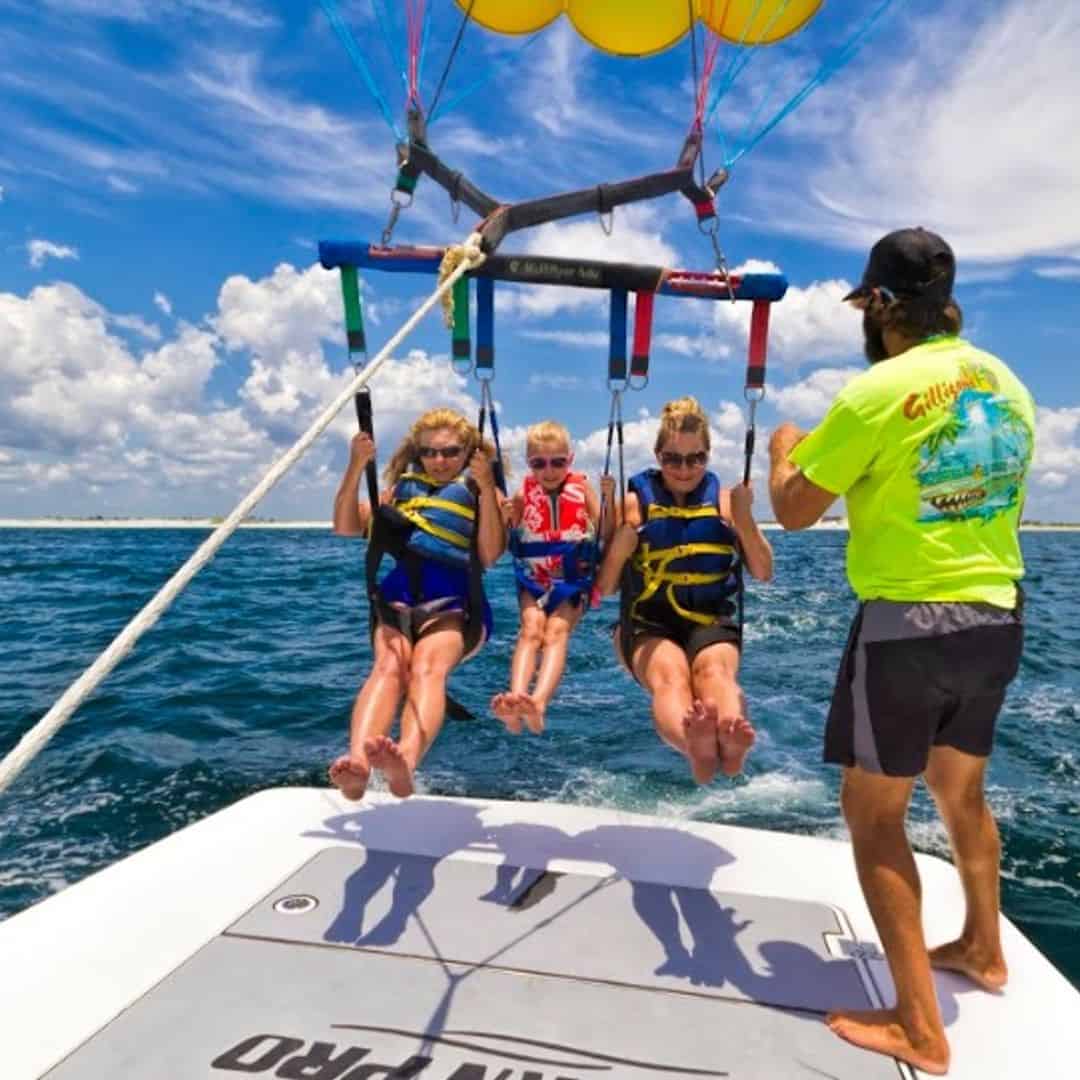
Answer: The biggest surprise for most first time flyers is just how smooth the whole process is. A lot of people picture being jerked into the air or dropping back onto the boat at the end, but that is really not what happens. When it is your turn, you are clipped into the harness while sitting on the back of the boat, and as the captain gradually increases speed, you simply start to lift off the deck. It almost feels like someone is gently pulling you upward instead of launching you. There is no big rush in your stomach like a roller coaster, and before you know it, the boat is getting smaller beneath you. The landing is just as easy. As the captain slowly brings you back toward the boat, the crew guides you in and you end up sitting right back where you started. If nobody told you it was time to land, you might not even realize how close you were until your feet are back on the deck. It is a very controlled process from beginning to end. If you choose to do a water dip, the captain will lower you just enough for your feet or legs to touch the surface before bringing you back up for the landing. Even that is usually gentle and feels more playful than exciting. After talking with thousands of visitors over the years, I can say the takeoff and landing are usually the parts people worry about the most before the trip and the parts they talk about the least afterward because they end up being so much easier than they expected.
Question: Can you stay completely dry while parasailing in Destin?
Answer: Yes, you absolutely can, and a lot of people do. Whether you stay dry really depends on the type of landing the captain gives you and sometimes what you request before your flight. Most parasailing crews in Destin offer what is called a dry landing, where you take off from the back of the boat and come right back onto the deck without touching the water at all. If you would rather get a little wet, many captains can also give you a gentle "dip" where your feet or lower legs skim the surface before bringing you back up. Some people love it because it adds a little extra fun, while others would rather stay completely dry so they can head to lunch or another activity afterward. If staying dry is important to you, just mention it before your flight. The crew hears that request all the time and will usually do everything they can to accommodate it as long as conditions allow. Keep in mind that even if you choose a dry landing, you are still out on a boat, so there is always a chance of getting a few splashes from the ride, especially if there is a little chop on the Gulf. It is never a bad idea to wear clothes that can handle a little salt water just in case. From what I have seen over the years, most people are surprised by how easy it is to stay dry if that is what they want, and those who choose the water dip usually come back laughing because it was much gentler than they expected.
Question: Is morning or afternoon better for parasailing in Destin?
Answer: If you have the flexibility, I usually recommend going in the morning. Around here the Gulf is often calmer earlier in the day, the temperatures are a little more comfortable, prices are less, and there is typically less boat traffic on the water. That can make the whole experience feel a little more relaxed, especially if it is your first time parasailing. The visibility is often excellent in the morning too, so you have a great chance of seeing the white sand beaches, the East Pass, Crab Island, and even schools of fish or dolphins if they happen to be nearby. That said, I would not avoid an afternoon trip if that is what fits your schedule. There are plenty of beautiful afternoons in Destin, and I have seen some amazing flights later in the day when the sun lights up the water in a completely different way. The biggest thing to keep in mind is that summer afternoons are more likely to have pop up thunderstorms, so morning trips have a better chance of staying on schedule without weather delays. If I were helping a friend book, I would tell them to grab one of the earlier time slots if they could, especially during the busiest months of the year. You will usually enjoy slightly cooler weather, smoother conditions, and a more relaxed pace before the beaches and waterways fill up. But honestly, if the weather is good, there is really no bad time to go.
Question: How high do you actually go when parasailing in Destin?
Answer: People are usually surprised by the answer because it feels much higher than it looks from the boat. Most parasailing companies in Destin use about 800 ft of tow line, but because of the angle of the rope, you are typically flying somewhere around 400ft above the water. That is high enough to see for miles in every direction without feeling like you are looking down from an airplane. From up there you can usually see the white sand beaches stretching along the coast, Destin Harbor, the East Pass, Crab Island, and on really clear days you can see much farther than you would ever expect. It gives you a completely different perspective of the area that you simply cannot get from the beach or even from a boat. The funny thing is that once you are in the air, most people stop thinking about the height after the first minute or so. Instead, they start looking for dolphins, watching boats move through the water, and taking in the scenery. The height becomes part of the view instead of something you are worried about. The captain also adjusts each flight based on the weather and wind conditions, so every trip is a little different. Safety always comes first, and they are not trying to send people as high as possible just for excitement. If you ask people after they land what they remember most, it is rarely the number of feet they were above the water. It is almost always the incredible view and how peaceful it felt once they were floating above the Gulf.
Question: What happens if you panic while you're already high in the air while parasailing?
Answer: It is a very common concern, but in reality it almost never happens. By the time you are high in the air, most people have already realized the experience is much calmer than they expected. You are sitting comfortably in a secure harness with very little movement, and there is really nothing you need to do except enjoy the view. If you do start to feel anxious, the best thing you can do is take a slow breath, look out toward the horizon instead of straight down, and remind yourself that the captain and crew are in complete control of the flight. They are watching you the entire time from the boat and can bring you back down whenever they need to. You are never up there by yourself. One thing that surprises first time flyers is how peaceful it becomes once the boat gets a little farther away. The engine noise fades, the breeze is gentle, and it almost feels like you are floating in place. That calm environment actually helps many nervous guests relax after the first few moments. In all the years I have watched people parasail in Destin, Truth is, parasailing is one of the safest water activity you can do. I have seen far more guests laugh about how worried they were beforehand than people who wanted to come down early. If you know you are afraid of heights, tell the crew before your flight. They are great at talking people through the process and helping nervous guests feel comfortable.
Question: When you are coming down, do they ever tell you ahead of time or does it just happen pretty quickly?
Answer: When you are coming down from parasailing, the crew usually gives you some kind of heads up before the landing starts. Most of the time, you can tell before they even say much because the boat starts adjusting speed, the line slowly begins coming in, and you feel yourself easing lower instead of staying at the same height. It is not like they suddenly drop you or pull you down fast. The descent is gradual, and once you notice the water and boat getting closer, you have plenty of time to realize you are on the way back in. If conditions are calm, the crew may shout or signal so you know they are bringing you down, especially if they are planning a foot dip or a dry landing. If it is windier or there is more boat noise, you may not hear every word, but they are still controlling it from the boat the whole time. The last part can feel a little quicker just because you are getting closer to the deck and the crew is lining everything up, but it still feels managed and steady.
Question: Do kids usually enjoy watching from the boat or do they get bored waiting for turns?
Answer: Kids do pretty well watching from the boat, especially if the wait is not too long and they can see the takeoffs and landings. There is usually enough going on to keep them interested for a while. They get to watch the chute open, see people lift off the back of the boat, spot their family in the air, and then watch the landing come back in. For a lot of kids, that part is almost as exciting as the flight because everything is happening right in front of them. Where boredom can creep in is on busier trips when there are several groups ahead of them, or if they are younger and not used to sitting still on a boat for 45min to 1hr. The boat ride itself can help because there is water, shoreline, birds, and sometimes dolphins or other boat traffic to look at, but I would still bring only a few things if they are just watching, like water, sunscreen, and maybe sunglasses. I would not bring a bunch of toys or loose stuff because boat space is limited. If the child is nervous, watching 1 or 2 flights first can actually help a lot because they see the takeoff and landing happen before it is their turn.
Question: Do they give you a life jacket automatically or do you have to ask for one?
Answer: Yes, they normally give you a life jacket automatically, you do not have to ask for one. For parasailing, it is part of the regular setup before you ever go up. The crew will usually get everyone seated, hand out life jackets, check the fit, then move into the harness process. Everybody wears one because you are on a boat, over open water, and the crew wants the same safety setup for each person. If you have a child, a smaller adult, or someone who feels like the fit is too loose or too tight, definitely say something right then because they usually have different sizes on board and can switch it before the flight. The life jacket may feel a little bulky at first, especially once the harness goes over it, but that is normal, and the crew will make sure everything sits the way it should. You are not expected to figure it out by yourself. They will buckle, tighten, check, and adjust as needed. Plan on wearing one automatically, and if it does not feel right, speak up before takeoff so they can fix it while you are still on the boat.
Question: If the water looks rough at the dock, does that usually mean parasailing will get canceled or can it still happen?
Answer: If the water looks rough at the dock, it does not always mean parasailing will be canceled, because the dock area can look choppy for reasons that do not tell the whole story. Sometimes you are seeing boat wakes, marina traffic, or wind bouncing around a protected area, and once the captain gets out to the flying zone, conditions may actually be smoother and more consistent. What matters more is steady wind, safe takeoff room, and whether the crew can bring you up and back down in a controlled way. With that said, rough water is still something they take seriously, especially if the chop is coming with gusty winds or storms nearby. If it is just a little bumpy, they may still run the trip but adjust where they go, wait a few minutes for traffic to clear, or keep the ride more conservative. If the wind is shifting hard or the boat cannot stay steady enough for safe takeoffs and landings, they will delay or cancel instead of trying to force it.
Question: Is parking usually close enough to the dock or do we need to plan extra time walking from a lot?
Answer: I would plan a little extra time for parking instead of assuming you can pull right up to the boat and hop on. Some operators do have parking close to the dock, especially if they are working out of a marina or waterfront location with a dedicated lot, but in summer, that lot can fill up fast, and you may end up parking farther away than expected. The walk is usually not terrible, but when you are carrying towels, phones, sunscreen, and maybe trying to get kids organized, even a short walk feels longer in the heat. I would give yourself at least 20 to 30min of cushion before check in, and more if you are going during a busy weekend, holiday week, or late morning when everyone is out moving around. The part people run into is not always the walk itself, it is finding the right lot, figuring out where the check in desk is, and making sure the whole group is together before the boat leaves. If your trip is early in the morning, parking is usually easier and closer. Later in the day, it can take a little more patience.
Question: If I wear glasses, do they usually stay on during the flight or should I take them off?
Answer: If you wear glasses, I would not count on them staying perfectly secure unless you have a strap on them. During the flight itself, there is not much to worry about, so glasses are not flying off every second, but there is still wind, boat movement, and that little shift when you lift off or come back down. Regular prescription glasses can stay on for some people, especially if they fit snug, but sunglasses that sit loosely on your face are a lot easier to lose. Most crews will tell you the same thing before you go up, either take them off or wear a retainer strap if you really need them. If you cannot see well without prescription glasses, bring one of those sunglass cords or sports straps, and you should be fine. If they are expensive or loose, I would leave them on the boat or in the car and not risk it. Once you are up there, you are not doing anything wild, but you are high over the water, so if something slips, it is gone. Contacts are usually the easiest option if you wear them, and cheap sunglasses with a strap are better than your favorite pair. The view is great, but it is not worth losing glasses over.
Question: How far in advance do I need to book during summer or can I still get something same day sometimes?
Answer: During summer, I would book parasailing a few days ahead if you have a certain day or time in mind, especially if you are trying to go in the morning or you have a bigger family group. Same day spots do happen, but they are much easier to find on weekdays, earlier in the season, or when you are flexible with timing. Once you get into peak vacation weeks, especially around holidays or busy weekends, the better slots can fill up fast because operators are also watching weather windows and trying to fit everyone into the calmer parts of the day. Morning trips are usually the ones people grab first because the water often feels smoother, and it is not as hot yet, so those can be harder to get last minute. Afternoon openings are sometimes easier, but that is also when wind or storms are more likely to affect the schedule. If you are booking for just 1 or 2 people, you might get lucky calling the same day, but for 4, 5, or more, I would not count on it. The safest way to think about it is to book early if parasailing is something you really want to do, then let the operator move you around if the weather becomes an issue.
Question: If we are booking for a bigger family group, do we all go together or do they split us into smaller flights?
Answer: For a bigger family group, you usually will not all go up in the parasail at the same time. They normally split everyone into smaller flights, most often 2 people at a time, and sometimes 3 if the weight balance, weather, and equipment setup allow it. The boat may take your whole group out together if there is enough room, but the actual flying part is done in rotations so the crew can keep each takeoff and landing controlled. They will usually look at everyone’s ages, comfort level, and combined weight before deciding who pairs up, so it may not be as simple as letting everyone choose without checking first. For example, a child might need to fly with an adult, or 2 heavier adults may need to go separately, depending on the wind that day. While 1 pair is up in the air, the rest of the family stays on the boat watching, taking pictures, and waiting their turn. If keeping certain people together matters, like siblings, couples, or a nervous kid with a parent, mention it when you check in. Crews will usually try to work with that as long as the weight and conditions are in line.
Question: Do they usually let you pick if you want to dip your feet in the water or is that something they just decide?
Answer: Most parasailing crews will ask or at least give you the option, but the final call is theirs because the dip depends on wind, boat speed, water traffic, and how smooth the landing path feels at that moment. A foot dip is pretty common, and a lot of people like it because it adds a little fun without turning the ride into a full water activity, but it is not something they can promise every single time. If the water is calm and the boat has plenty of room, they may lower you just enough for your feet or legs to skim the water before bringing you back up or setting up for the return. If it is choppy, windy, crowded, or the crew is trying to keep the chute extra steady, they may skip it and bring you straight back to the boat. The best move is to tell them before you go up if you really want the dip or if you would rather stay completely dry. Most crews are happy to work with your preference when the day allows it.
Question: If it is a really hot day, does it feel cooler once you are up in the air or is it still pretty warm?
Answer: On a really hot day in the area, it usually does feel cooler once you are up in the air, but I would not think of it as instant air conditioning. The biggest difference is the breeze. Down on the boat, especially while you are waiting for your turn, the sun can feel strong because you are sitting close to the water with heat bouncing around and not much shade. Once the parasail lifts, you get steady airflow around you, and that moving air makes it feel a lot more comfortable than it did on deck. Most people notice the temperature feeling lighter pretty quickly, especially once they are high enough that the boat noise fades and the breeze is constant. That said, the sun is still hitting you the whole time, so you can still get hot or burned if you skip sunscreen. You will not be escaping the summer heat completely, you will just get relief from the still, sticky feeling you sometimes have while waiting on the boat. If there is a nice Gulf breeze that day, the flight can feel pleasant even when the dock feels miserable.
Question: If someone in our group decides last minute they do not want to go up, does that mess up the booking or can they just sit it out?
Answer: If someone in your group gets nervous at the last second and decides they do not want to go up, it will not ruin the whole booking, but how it is handled depends on the operator and where you are in the process. Most parasailing crews in the area see this happen from time to time, so they are not shocked by it, and they will usually let that person sit it out on the boat if there is space and everything still works with the group setup. The main thing is payment and timing. If they were booked as a flyer, you should not assume you will automatically get a refund just because they changed their mind right before takeoff, especially if the boat has already left or the crew held a spot for them. If they decide before boarding, there may be more flexibility, but once the trip is underway, it is usually treated differently. From another side, it can affect flight pairings if they were supposed to go tandem with someone else, so the crew may have to adjust who flies together based on weight, wind, and harness setup.
Question: Is there usually a place to leave phones and small bags safely or should we just leave everything in the car?
Answer: I would not bring much with you unless you really need it, because storage on the boat is usually limited, and it is not like having a locker room or a secure cubby waiting on board. Most boats can handle a small dry bag, phone, towel, sunglasses, and maybe a tiny personal bag, but they do not want everyone bringing big beach bags, purses, or loose stuff that slides around while people are moving in and out of harnesses. If you want your phone for photos, bring it in a waterproof pouch or keep it tucked away until you are seated, because spray and boat movement can happen even when the ride feels calm. Some crews may have a dry box or a spot near the console where small items can stay, but I would not treat that like guaranteed secure storage. The safest move is to leave anything important in the car or back at your condo, especially wallets, extra keys, jewelry, and anything you would be upset to lose or get wet. Bring only what you actually need for the ride, and keep it simple. A phone, ID, payment card if needed, and maybe a small waterproof bag are usually plenty.
Question: How strict are they about age or weight limits?
Answer: They are pretty strict about age and weight limits because parasailing depends so much on wind, harness fit, and how the chute handles the combined weight in the air. Around Gulf Shores and Orange Beach, you will usually see minimum age rules, minimum weight rules, and total combined weight limits for tandem or triple flights, but the exact numbers can change by company and by conditions that day. A group might meet the general weight range on paper, but if the wind is light or gusty, the crew may pair people differently or decide someone needs to fly with another person instead of alone. Kids usually need to be old enough to follow directions and fit securely in the harness, so it is not just about age alone. Weight limits are treated even more carefully because they affect lift and control. If you are close to the cutoff, it is better to mention it when booking instead of waiting until you are on the boat. Most of the time, they can work with families by adjusting flight pairings, but they are not going to bend a safety rule just to squeeze someone in.
Question: If we are not great swimmers, do we need to worry about anything at all when we are on the boat or up in the air?
Answer: If you are not great swimmers, that is not a big reason to worry about parasailing, because the whole setup is designed so you take off from the boat and land back on the boat. You are not expected to swim out, tread water, or climb around in the Gulf to start the ride. Everyone wears a life jacket, and the crew keeps you seated, clipped in, and guided through each step before you ever leave the deck. The part that matters most is being comfortable following simple directions, like sitting back in the harness, keeping your legs relaxed, and listening when they bring you in for landing. Most people who are nervous about swimming actually feel better once they realize they are not being dropped into the water as part of the normal flight. Sometimes crews offer a little foot dip, but that is usually optional and based on weather, wind, and how the ride is going. If someone really does not want to touch the water, it is worth saying that before the flight, so the crew knows. The boat ride itself is usually the only part where a weak swimmer might feel a little uneasy, just because you are surrounded by open water, but you are seated, wearing a life jacket, and with the crew the whole time.
Question: For people who are nervous at first, what part of the experience usually helps them relax the most?
Answer:
Question: Waves vs wind, which one actually affects parasailing more?
Answer:
Question: Do they ever skip certain launch spots if boat traffic gets too heavy that day?
Answer:
Question: If someone just wants to ride along and not parasail, is that usually allowed on the boat?
Answer:
Question: When you land back on the boat, do most people stay dry or get splashed?
Answer:
Question: In a mixed group, how do they decide who goes first?
Answer:
Question: If someone is scared of heights, do they usually talk them through it while they are in the air or mostly beforehand?
Answer:
Question: Do they walk you through what the harness will feel like before you actually go up?
Answer:
Question: For someone who has never been on a boat before, what can I expect during takeoff?
Answer:
Question: If the weather looks iffy, do they cancel early or wait until closer to the time?
Answer:
Question: Once you are in the air, do you have any interaction with the crew or is everything handled from the boat?
Answer:
Question: When you are coming back down, does the landing feel controlled or is it quick?
Answer:
Question: If someone gets motion sick easily, is it the boat ride or the flight that usually bothers them more?
Answer:
Question: How far out do you usually travel before you actually start parasailing and does that change depending on conditions?
Answer:
Question: If we have a teenager going up for the first time, do they ever keep the height a bit lower or is it the same for everyone?
Answer:
Question: If someone in our group is nervous about heights, do they get a little extra time to settle in before going up or is it pretty quick?
Answer:
Question: If the wind shifts while people are already booked, do they usually delay things or just adjust how the ride goes?
Answer: If the wind shifts after you are already booked for parasailing, it is usually not a straight delay or cancel situation right away. They start adjusting the plan in real time based on what the water is actually doing. Most crews are watching wind direction constantly, so they are already thinking a few steps ahead before anyone even gets on the boat. If it is just a moderate shift, they will change things like where they launch from, how far offshore they go, or how long they stay in one area, rather than stopping the whole trip. Where you will see more changes is if the wind picks up enough to make takeoff or landing less comfortable, or if there are steady gusts that build chop on the water. In those cases, they might delay the start a bit or push things back until it settles, but they try hard not to waste your time sitting around if it is still safe to go. Most of the time, it ends up being a small adjustment rather than a full schedule change, and only occasionally does it turn into a delay if conditions really start to stack against a safe takeoff or landing.